



The Federal Reserve is often the most closely watched institution in global finance, and its decisions can ripple through everything from stock prices to mortgage rates. Whether you’re a trader, investor, or simply trying to understand the economy, the Fed’s actions—and even its words—can move markets and shape financial outcomes around the world.
In this article, we’ll break down what the Fed is, how it sets U.S. monetary policy, and why its decisions have such a big impact around the world.
1. What Is the Federal Reserve?
The Federal Reserve, often referred to as the Fed, is the central banking system of the United States. It was established by the U.S. Congress in 1913, with the primary goal of ensuring the stability and security of the U.S. financial system.
The Fed is composed of three key components:
- The Board of Governors
- 12 regional Federal Reserve Banks across the country
- The Federal Open Market Committee (FOMC)
The current Chair of the Federal Reserve is Jerome Powell. As the central bank of the U.S., the Federal Reserve has the authority to formulate and implement monetary policy, as well as to regulate and supervise financial institutions.
2. Main Objectives of the Federal Reserve
The Fed’s core mission is to ensure the safety and stability of the financial system, with their key goals are to promote price stability (inflation) and maximum employment.
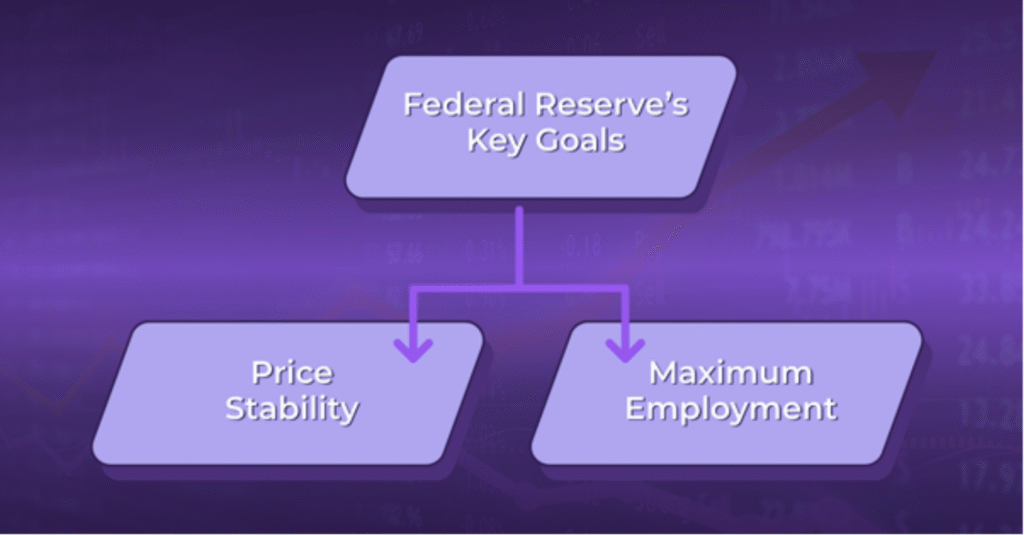
To achieve these goals, the Fed uses several tools, primarily through:
- Monetary Policy – including:
- Setting the Federal Funds Rate
- Controlling the supply of U.S. dollars
- Other Key Responsibilities:
- Supervising and regulating U.S. financial institutions
- Facilitating interbank transactions (e.g., check clearing, electronic payments)
- Supporting financial system development (e.g., housing finance, debt markets, and community investments)
Among these responsibilities, monetary policy is the most closely watched by financial markets, as it tends to have the most significant impact on interest rates, inflation expectations, and asset prices.
This brings the focus to the Federal Open Market Committee (FOMC), which is responsible for making key decisions on U.S. monetary policy.
To understand how the Fed carries out these objectives in practice, it’s essential to examine the role of the Federal Open Market Committee (FOMC)—the policymaking body behind the most market-moving decisions.
3. What Is the Federal Open Market Committee (FOMC)?
The Federal Open Market Committee (FOMC) is the branch of the Federal Reserve responsible for setting U.S. monetary policy, particularly through open market operations—the buying and selling of U.S. Treasury securities to manage the money supply and influence interest rates.
The FOMC is composed of 12 voting members:
- 7 members from the Federal Reserve Board of Governors
- The President of the Federal Reserve Bank of New York
- 4 rotating presidents from the remaining 11 regional Federal Reserve Banks (rotating on a yearly basis)
The Federal Open Market Committee (FOMC) meets eight times a year to review U.S. economic and financial conditions and to decide on monetary policy actions—such as adjusting the federal funds rate or conducting asset purchases.
These decisions often have significant implications for financial markets, making each meeting a key event for traders and investors.
3.1 FOMC Meeting
Meeting dates are announced in advance, and FOMC minutes—which offer deeper insight into the Fed’s thinking—are typically released about three weeks later. Traders often follow economic calendars to track upcoming FOMC meetings and anticipate potential market-moving decisions.
4. How Does the Fed Implement Monetary Policy?
The Federal Reserve implements monetary policy primarily to achieve its dual mandate: price stability and maximum employment. To do this, the Fed uses several key tools to influence the availability and cost of money in the economy:
4.1. Federal Funds Rate (Interest Rate Policy)
The Fed’s most well-known tool is the federal funds rate—the interest rate at which banks lend reserves to each other overnight.
- Raising the rate makes borrowing more expensive, which cools down inflation but can slow economic growth.
- Lowering the rate makes borrowing cheaper, encouraging spending and investment, which supports economic expansion.
The FOMC sets a target range for this rate and uses open market operations to guide it within that range.
4.2 Open Market Operations (OMO)
These are the Fed’s day-to-day operations of buying or selling U.S. Treasury securities in the open market to influence liquidity:
- Buying bonds injects cash into the banking system, lowering interest rates and encouraging lending.
- Selling bonds pulls money out of the system, raising interest rates and tightening financial conditions.
4.3. Reserve Requirements
This is the minimum amount of reserves banks must hold. While rarely adjusted, a lower reserve requirement increases the money available for lending, while a higher one restricts it.
4.4. Discount Rate
This is the interest rate the Fed charges banks for direct loans through its discount window. Adjusting this rate influences short-term liquidity in the banking system.
4.5. Forward Guidance
The Fed also uses communication as a policy tool by signaling its future policy intentions, which helps shape market expectations even before any action is taken—dovish means leaning toward rate cuts to support growth, while hawkish suggests rate hikes to curb inflation.
5. How Does the Fed Impact Global Financial Markets?
As the world’s largest economy and with the U.S. dollar serving as the global reserve currency, The Fed’s monetary policy decisions can significantly affect various segments of the financial markets, including stocks, bonds, and currencies. Here’s how:
1. Stock Market
- Rate Cuts (Dovish Policy): Lower interest rates reduce borrowing costs, encourage corporate investment, and boost consumer spending—all of which can lift corporate earnings and support higher stock prices.
- Rate Hikes (Hawkish Policy): Higher rates increase borrowing costs, reduce profit margins, and may cool economic growth. This often leads to volatility or downward pressure on stock prices.
2. Bond Market
- Interest rates and bond prices move inversely. When the Fed raises rates, newly issued bonds offer higher yields, making existing lower-yielding bonds less attractive—causing their prices to fall.
- Expectations of future rate moves are often priced into bond yields, especially for U.S. Treasuries.
3. Currency Market
- A rate hike typically strengthens the U.S. dollar, as higher yields attract foreign capital.
- A rate cut may weaken the dollar, as investors seek higher returns elsewhere.
- Fed policy decisions are closely watched by forex traders and often lead to sharp moves in USD-related currency pairs (e.g., EUR/USD, USD/JPY).
4. Gold and Commodities
- Lower rates and a weaker dollar often support gold and commodity prices, as the opportunity cost of holding non-yielding assets like gold decreases.
- Higher rates and a stronger dollar may pressure commodity prices, especially those priced in USD.
In summary, the Federal Reserve plays a central role not just in shaping U.S. economic conditions but also in influencing global financial markets. Whether you’re a trader, investor, or simply a global citizen, understanding how the Fed operates can help you better navigate the complex world of finance.
6. Practical Takeaway for Investors & Traders
For investors and traders, staying attuned to the Federal Reserve’s policy direction is essential. Whether it’s interpreting a subtle shift in tone during an FOMC press conference or analyzing key inflation data ahead of a meeting, understanding the Fed’s influence can offer a valuable edge in anticipating market moves.
As global markets remain highly sensitive to interest rate decisions and forward guidance, keeping a close watch on the Fed isn’t just about economic curiosity—it’s a critical part of risk management and strategy.